Industrial robots already repeat the same motion for hours. The next step is giving them more useful choices when a part moves, a tool wears, or a worker changes the job. For factory managers, that shift matters more than a robot’s shape.
- Fixed arms will keep handling high-volume tasks.
- Cameras and software will help robots work with changing parts.
- Safety checks, training data, and service plans will limit adoption.
The arm stays, but the job changes
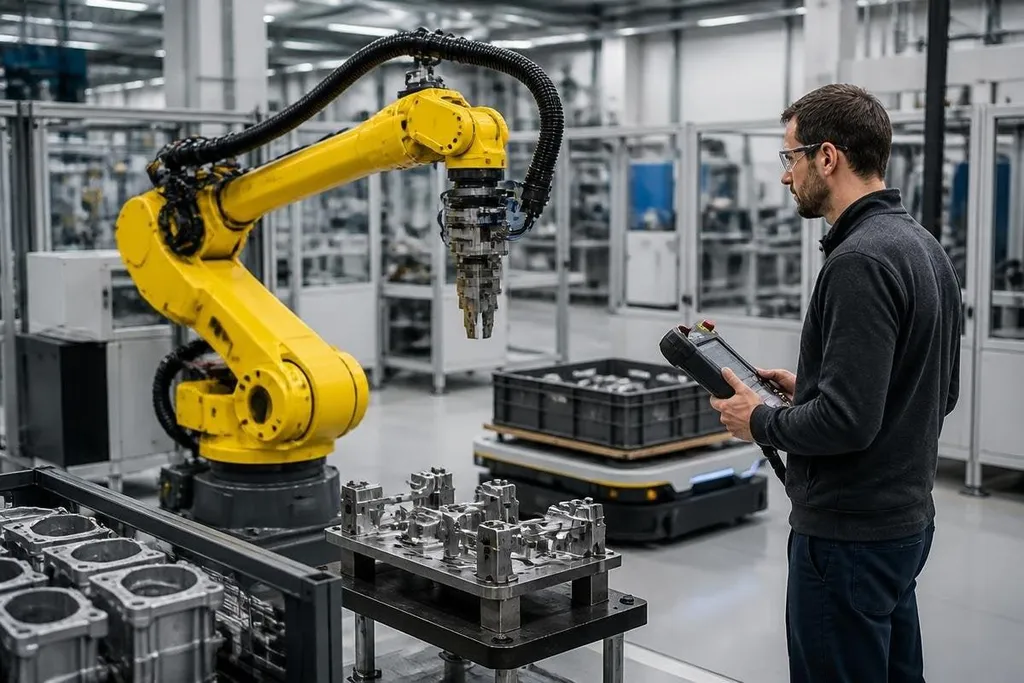
A fixed robotic arm works well when its position, tool, and task stay known. That setup suits welding, painting, assembly, and packaging lines where engineers can control the work area closely.
Factories rarely stay fixed forever. A new product may need a different grip, a different screw pattern, or a new inspection step. Each change can call for new fixtures, software, safety checks, and line testing.
The robot may still move well, but the wider system takes time to reset. Future systems will need to read more of that changing scene.
A camera can locate a part, while force sensing can tell the robot when a gripper has made contact. Software can then adjust the motion instead of sending the same command every cycle.
That does not make the robot independent. It gives the robot a narrower set of choices inside rules written by engineers. The useful question is how often those choices work without a person correcting the task.
Mobile robots will take work to the arm
A robot arm fixed to one frame cannot reach every shelf, machine, or pallet. A mobile base can carry the arm across a factory, but movement adds new problems: floor conditions, people crossing the route, charging, and safe stopping.
This pairing could reduce the need for a separate robot at every station. One system might move parts, load a machine, then carry a finished item to inspection. The plan only makes sense when travel time, battery use, and safety controls fit the production cycle.
A factory handoff deserves a named machine, work site, and result. Robot24.com can put those facts beside the claim before you count travel time as a real saving.
The hard part is handoff. A mobile robot must arrive in the right place, present the part in a usable position, and leave without blocking people or equipment. A missed handoff can erase the time saved by removing a manual trip.
People will still set the limits
Factories will need workers who can set up robot cells, check sensors, repair grippers, and review failed tasks. More flexible robots may change those jobs, but they won't remove the need for people who understand the process around the robot.
Safety will shape the layout. A robot that works near people needs speed limits, force limits, protective sensing, and a clear stop method. A system that performs well in a test cell may need slower movement on a busy production floor.
Training data will matter too. A camera system may handle clean parts in steady light and struggle with oil, glare, dust, or damaged packaging. Manufacturers will need to test those conditions before they count a task as ready for regular work.
The same limit applies to systems that use remote human control. Teleoperation can help a robot recover from an unusual situation, but a remote operator still adds cost and delay. The factory must know which failures need a person and how quickly that person can respond.
What to check before buying
Use this list when a supplier presents a flexible industrial robot:
- Name the task: record the part types, cycle time, reach, payload, and allowed error.
- Test the bad cases: include glare, damaged parts, blocked views, tool wear, and small layout changes.
- Measure the handoff: time loading, unloading, inspection, and recovery after a missed pick.
- Check the stop system: find the emergency stop, safe speed settings, and restart procedure.
- Price the people: include setup, training, service visits, spare grippers, and software changes.
- Set a pass mark: decide the error rate and recovery time the cell must meet before purchase.
The opposing view has weight: factories may prefer simple fixed cells because they are easier to test and repair. I'd choose flexibility only when the product changes often enough to repay that extra software, sensing, and service work.
Industrial robots will likely become better at handling small changes before they handle every task in a factory. The next useful measure won't be a humanoid shape; it will be how many production changes a cell can absorb before an engineer has to rebuild it.